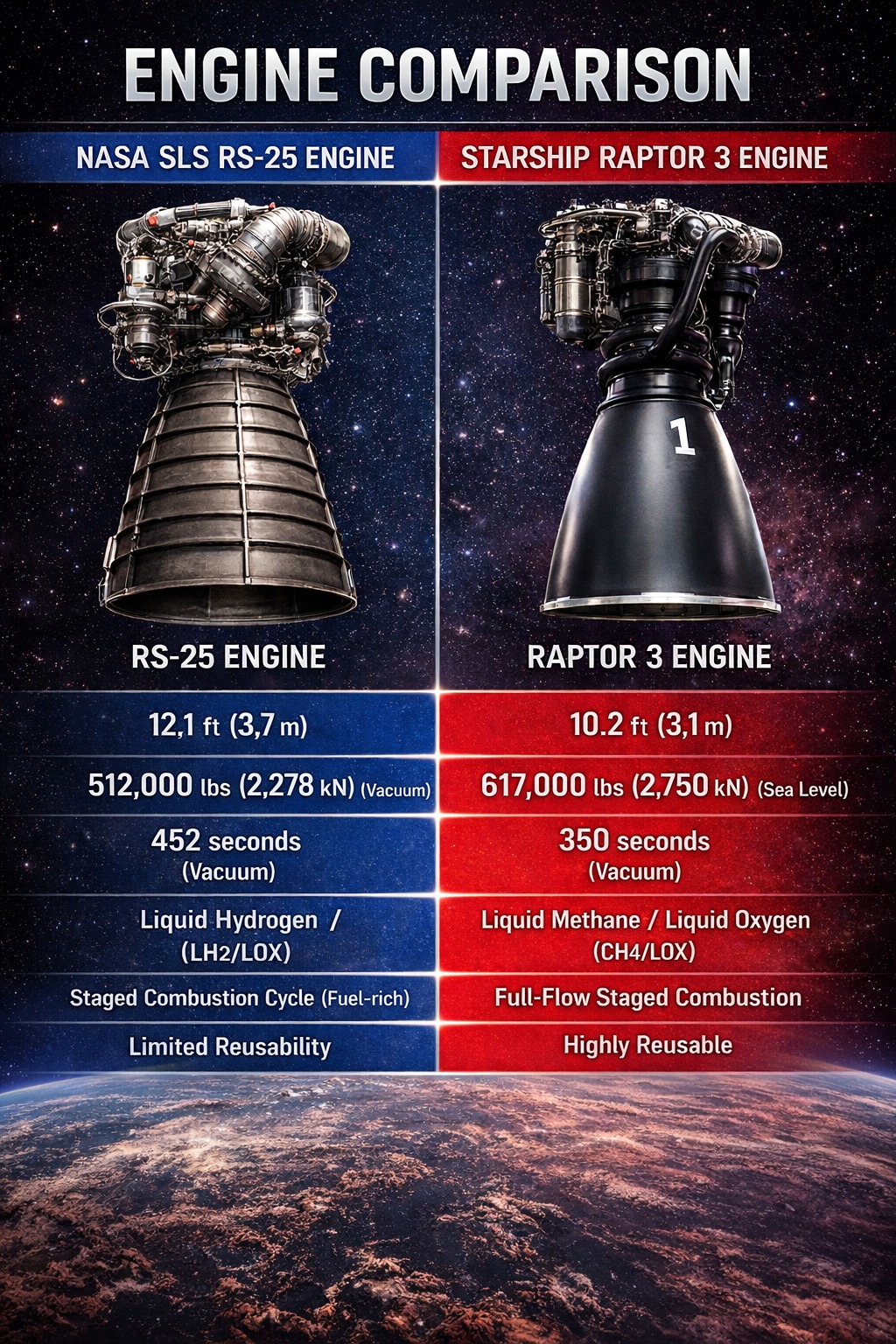
The battle between NASA's legendary RS-25 and SpaceX's revolutionary Raptor 3 represents two fundamentally different philosophies in rocket propulsion. The RS-25, born from the Space Shuttle program in the 1970s, epitomizes proven reliability and maximum efficiency. The Raptor 3, developed for complete reusability and rapid production, represents modern aerospace engineering optimized for high flight rates and low costs.
This comparison examines both engines across technical performance, operational characteristics, economics, and mission suitability to help aerospace professionals, space enthusiasts, and policymakers understand which engine excels in different scenarios.
Quick Recommendation
Choose RS-25 if:
- Maximum fuel efficiency is critical - RS-25's hydrogen propulsion delivers 450+ seconds specific impulse
- Using existing infrastructure - Ground systems and fuel handling already configured for hydrogen
- Single-use expendable missions - Where reusability isn't required and you need proven heritage
- Congressional mandates require it - Political requirements for Space Shuttle component reuse
Choose Raptor 3 if:
- Reusability is essential - Designed for 100+ flights with minimal refurbishment
- Cost per launch matters - 10x lower engine cost and operational expenses
- High launch cadence needed - Rapid turnaround and simplified operations
- Mars missions planned - Methane can be produced on Mars for return flights
- Landing capability required - Deep throttling enables propulsive booster recovery
The Strategic Reality:
NASA currently uses RS-25 for SLS because the program was designed around existing Space Shuttle engines before Raptor existed. SpaceX uses Raptor for Starship's fully reusable architecture. Both engines serve their respective programs, but represent incompatible design philosophies that cannot be swapped without complete vehicle redesign.
Technical Specifications Comparison
| Specification | NASA RS-25 | SpaceX Raptor 3 |
|---|---|---|
| Thrust (Sea Level) | 512,000 lbf (2.3 MN) | 580,000 lbf (2.6 MN) |
| Thrust (Vacuum) | 550,000 lbf (2.4 MN) | Not optimized for vacuum |
| Specific Impulse (Sea Level) | 366 seconds | 327 seconds |
| Specific Impulse (Vacuum) | 452 seconds | 350 seconds |
| Propellant | Liquid Hydrogen / LOX | Liquid Methane / LOX |
| Combustion Cycle | Staged Combustion | Full-Flow Staged Combustion |
| Chamber Pressure | 3,000 psi (207 bar) | 5,000+ psi (345+ bar) |
| Thrust-to-Weight Ratio | ~73:1 | ~200:1 |
| Throttle Range | 67-109% | 40-100%+ |
| Engine Cost | $60 million per engine | $1-2 million per engine |
| Design Life | 55 missions (Shuttle era) | 1,000+ missions (designed) |
| Reusability | Was reusable, now expendable on SLS | Fully reusable, minimal refurbishment |
| Development Era | 1970s-1980s | 2012-present |
| First Flight | 1981 (Space Shuttle Columbia) | 2019 (Starhopper) |
| Production Rate | ~4 per year | 500+ per year (target) |
Architecture & Design Philosophy
RS-25: Maximum Efficiency Legacy
The RS-25 represents 1970s aerospace engineering at its absolute peak, designed when hydrogen was considered the ultimate rocket fuel and reusability meant the Space Shuttle's airplane-like returns.
Staged Combustion Excellence: The RS-25 uses staged combustion where fuel-rich pre-burners drive high-pressure turbopumps before main combustion. This delivers exceptional specific impulse, making the RS-25 one of the most fuel-efficient rocket engines ever built.
Hydrogen's Trade-offs: Liquid hydrogen provides unmatched energy per unit mass (specific impulse of 452 seconds in vacuum), but comes with severe penalties:
- Extremely low density requires massive tanks
- Cryogenic storage at -423°F creates handling challenges
- Prone to leaks through microscopic gaps
- Requires extensive insulation adding weight
- Cannot be stored long-term for space missions
Shuttle Heritage, SLS Reality: Originally designed for 55 missions with refurbishment, RS-25 engines flew multiple Space Shuttle missions. Ironically, on SLS these proven reusable engines are discarded after single use because recovery infrastructure would cost more than the mission budget allows.
Raptor 3: Modern Reusability First
SpaceX designed Raptor from clean sheet for Starship's fully reusable architecture where both booster and ship return to Earth for rapid relaunch.
Full-Flow Staged Combustion: Raptor employs the most complex combustion cycle ever flown operationally. Unlike RS-25's fuel-rich staged combustion, Raptor runs both fuel-rich and oxygen-rich pre-burners that meet in the main chamber after driving separate turbopumps. This eliminates dead-end flow paths and pushes combustion pressure above 5,000 psi, delivering exceptional performance from methane despite lower theoretical efficiency than hydrogen.
Methane's Advantages: Liquid methane at -260°F provides practical benefits:
- Higher density than hydrogen means smaller tanks
- Warmer storage temperature simplifies operations
- Burns cleaner than kerosene (RP-1), preventing coking
- Less prone to leaks, safer handling
- Can be produced on Mars from atmospheric CO₂ and water ice for return missions
- Longer-term storage for space missions
Mass Production Philosophy: Where RS-25 represents artisanal aerospace engineering with each engine carefully assembled, Raptor targets automotive-style mass production. SpaceX aims to build 500+ Raptor engines annually, treating them as consumable components like tires rather than precious artifacts.
Performance Analysis
Raw Thrust Comparison
Raptor 3 wins on thrust-to-weight ratio by nearly 3:1. At roughly 1,250 pounds, Raptor 3 produces 580,000 pounds thrust (2.6 MN) for a thrust-to-weight ratio approaching 200:1. The 7,000-pound RS-25 produces 512,000 pounds thrust (2.3 MN) for a 73:1 ratio.
This matters because rocket performance depends on total vehicle mass. Using lighter engines means more payload capacity or fuel. Super Heavy's 33 Raptor engines weigh about 41,250 pounds combined while producing 19.1 million pounds of thrust. Four RS-25 engines weigh 28,000 pounds while producing 2.05 million pounds thrust. Raptor's superior thrust-to-weight enables Starship's massive capabilities despite smaller individual engine thrust.
Fuel Efficiency: RS-25's Enduring Advantage
RS-25 dominates on specific impulse, the fundamental measure of rocket fuel efficiency. At 452 seconds vacuum specific impulse, RS-25 extracts more momentum from every pound of propellant than nearly any other operational engine.
Raptor 3's 350 seconds vacuum specific impulse means roughly 23 percent less efficiency. For missions where every pound of propellant matters - like single-use expendable launches to distant destinations - this efficiency gap favors RS-25.
However, this comparison misleads because it ignores total mission architecture. Starship's reusability means the entire vehicle returns to fly again, while SLS discards engines worth $240 million after single use. The efficiency advantage evaporates when accounting for the economics of throwing away highly efficient engines.
Throttle Range and Landing
Raptor's deep throttling enables propulsive landing that's impossible with RS-25 architecture. Raptor can throttle down to 40 percent or lower, meaning Super Heavy can land on just 3 engines running at minimum thrust - less than 10 percent of liftoff power. This precise throttling enables the spectacular booster catches and landings that define Starship operations.
RS-25 throttles from 67 to 109 percent, optimized for ascent performance not landing. A hypothetical Super Heavy with five huge RS-25-class engines couldn't land because a single engine at minimum throttle would have too much thrust for the empty booster weight, causing it to ascend rather than land gently.
Chamber Pressure: Raptor's Engineering Triumph
Raptor's 5,000+ psi chamber pressure represents a significant engineering achievement. Higher chamber pressure generally improves performance and reduces engine size for equivalent thrust. RS-25's 3,000 psi was exceptional for 1970s technology. Raptor's full-flow staged combustion enables the pressure increase that would be difficult with RS-25's architecture.
Cost Analysis
Engine Purchase Price
RS-25: $60 million per engine (NASA's expenditure for current fleet) Raptor 3: $1-2 million per engine (estimated based on SpaceX statements and production targets)
For SLS's four RS-25 engines: $240 million in propulsion alone, discarded after 8 minutes of operation.
For Starship's 33 booster + 6 ship Raptors: $39-78 million total, designed to fly 100+ missions with minimal refurbishment.
The cost gap reflects fundamental production philosophies. RS-25 engines are precision instruments assembled by aerospace engineers treating each component as critical hardware. Raptor engines use automotive-style mass production with standardized processes, extensive automation, and acceptance that some engines will fail - just build more.
Operating Costs
Hydrogen operations are expensive:
- Specialized ground equipment for -423°F liquid hydrogen
- Extensive safety systems for highly explosive fuel
- Constant boil-off requiring continuous replacement
- Launch pad modifications for hydrogen handling
- Environmental controls for hydrogen atmosphere
Methane operations are cheaper:
- Warmer temperature (-260°F) simplifies equipment
- Lower explosion risk than hydrogen
- Minimal boil-off, easier storage
- Standard cryogenic equipment
- Faster turnaround times
Mission Economics
SLS per launch: $2-4 billion (vehicle cost), single use Starship per launch: $10-100 million estimated (fully reusable)
The economics aren't comparable. SLS resembles airline tickets that include purchasing a new airplane for each flight. Starship resembles normal commercial aviation where vehicles fly repeatedly.
Reusability Comparison
RS-25: Built Reusable, Used Expendable
The profound irony: RS-25 was meticulously engineered for reusability and successfully flew multiple Space Shuttle missions. Individual engines completed 12+ flights with refurbishment.
On SLS, these same engines are discarded into the ocean after single use. Why? Because SLS lacks the infrastructure to recover and refurbish engines, making reuse more expensive than disposing of them. Congressional requirements to reuse Shuttle components created the paradox of reusable engines being used expendably.
Raptor: Designed for Rapid Reuse
Raptor targets 1,000+ mission life with minimal refurbishment between flights. This explains design choices that prioritize durability over maximum performance:
- Robust construction tolerates repeated thermal cycling
- Clean-burning methane prevents coking that degrades engines
- Simplified maintenance with modular components
- Rapid inspection and replacement procedures
- Extensive sensor suite monitors engine health
SpaceX flew Falcon 9 boosters 20+ times using Merlin engines. Raptor aims even higher reusability through improved materials, better cooling, and operational experience.
Refurbishment Requirements
RS-25 between Shuttle flights:
- Extensive disassembly and inspection
- Component replacement and testing
- Months of refurbishment work
- Return to flight certification
Raptor between Starship flights (target):
- Visual inspection
- Sensor data analysis
- No disassembly unless problems detected
- Hours to days of turnaround
The reusability philosophy differs fundamentally. RS-25 refurbishment assumed deep maintenance like jet engine overhauls. Raptor aims for airliner-style operations where routine flights require minimal servicing.
Mission Suitability
Launch Vehicle Applications
RS-25 excels at:
- Heavy lift expendable missions where engine cost is accepted
- Maximum payload to high-energy orbits requiring peak efficiency
- Missions leveraging existing hydrogen infrastructure
- Government programs with ample budgets and long timelines
Raptor excels at:
- Rapid-reuse orbital operations
- High launch cadence requirements (100+ launches per year)
- Cost-sensitive commercial missions
- Landing-required architectures
Deep Space Missions
RS-25 advantages:
- Maximum fuel efficiency extends range
- Proven deep space heritage from Shuttle orbital missions
- Hydrogen upper stages are industry standard
RS-25 disadvantages:
- Hydrogen boil-off prohibits long-duration missions
- Cannot refuel in space (boil-off losses)
- No in-situ propellant production capability
Raptor advantages:
- Methane can be synthesized on Mars using Sabatier process
- Minimal boil-off enables long space storage
- Deep space refueling architectures possible
- Same engines on both stages simplifies logistics
Raptor disadvantages:
- Lower specific impulse requires more propellant mass
- Requires orbital refueling for high-energy missions
Mars Architecture Implications
Raptor is specifically designed for Mars. SpaceX's Mars colonization plan requires:
- Starship reaches Mars orbit
- Lands on Mars surface using Raptor engines
- Produces methane fuel from Mars atmosphere CO₂ and subsurface ice
- Launches from Mars back to Earth using Mars-made propellant
This architecture is impossible with hydrogen engines. Mars has no hydrogen sources that could produce liquid hydrogen fuel for return flights. Methane's suitability for in-situ resource utilization makes it the only realistic choice for reusable Mars missions.
RS-25's hydrogen propulsion excels for Earth-based operations with extensive ground infrastructure but becomes a liability for planetary missions requiring refueling.
Pros and Cons Analysis
NASA RS-25 Engine
Pros ✅
Unmatched Fuel Efficiency: 452 seconds vacuum specific impulse remains best-in-class among operational hydrogen engines, delivering maximum performance per pound of propellant.
Proven Flight Heritage: Over 500 successful Space Shuttle flights and Artemis 1 validation provide unmatched operational reliability.
Maximum Payload Performance: Higher efficiency means more payload capacity on expendable missions where engine recovery isn't required.
Existing Infrastructure: Launch facilities, ground systems, and operational procedures already configured for hydrogen operations at multiple NASA facilities.
Congressional Support: Mandated use of Shuttle components ensures political backing and continued funding regardless of cost-effectiveness.
Deep Technical Knowledge: Decades of RS-25 operational experience provide comprehensive understanding of engine behavior, failure modes, and performance optimization.
Quality Assurance: Artisanal production ensures each engine receives meticulous attention, reducing manufacturing defects.
Cons ❌
Extremely High Cost: At $60 million per engine, four RS-25s cost $240 million - thrown away after 8 minutes on SLS despite being designed for reuse.
Hydrogen Operational Challenges: Cryogenic storage at -423°F, constant boil-off, leak-prone connections, extensive safety systems, and complex ground operations increase costs and extend launch timelines.
Production Bottleneck: Building ~4 engines per year cannot support high launch cadences required for ambitious space programs.
Heavy Engine Mass: At 7,000 pounds, RS-25 has poor thrust-to-weight ratio compared to modern engines, reducing overall vehicle performance.
1970s Engineering: Design predates modern materials science, manufacturing techniques, computational design optimization, and lessons from commercial aerospace.
Expendable on SLS: The irony of discarding reusable engines wastes development investment and makes each launch extraordinarily expensive.
Hydrogen Boil-off: Prohibits long-duration space missions or planetary surface operations requiring fuel storage.
No Throttle for Landing: Cannot throttle low enough for propulsive landing, preventing booster recovery that could reduce launch costs.
Complex Maintenance: Shuttle-era refurbishment required extensive disassembly, inspection, and recertification between flights.
No Mars Fuel Production: Hydrogen unavailability on Mars prevents in-situ propellant production for return missions.
SpaceX Raptor 3 Engine
Pros ✅
Ultra-Low Cost: $1-2 million per engine enables affordable mass production, making engine failure acceptable when you can easily replace it.
Rapid Mass Production: Target of 500+ engines per year supports aggressive launch schedules impossible with artisanal RS-25 production.
Excellent Thrust-to-Weight: At ~200:1, Raptor delivers more thrust per pound of engine mass than any operational large engine, maximizing vehicle performance.
Full Reusability: Designed for 1,000+ missions with minimal refurbishment enables Starship's transformative economics.
Deep Throttling: 40 percent minimum throttle enables propulsive landing that's impossible with RS-25, allowing complete vehicle recovery.
Methane Advantages: Higher density than hydrogen reduces tank size, warmer storage temperature (-260°F vs -423°F) simplifies operations, clean burning prevents engine coking, minimal boil-off enables space storage.
Mars ISRU Compatible: Methane can be synthesized on Mars using atmospheric CO₂ and water ice via Sabatier process, enabling reusable Mars missions.
Modern Engineering: Clean-sheet 2010s design leverages modern materials (3D printing, advanced alloys), computational design optimization, and reusability lessons from Falcon 9.
Full-Flow Staged Combustion: Most efficient combustion cycle ever operationally deployed, achieving 5,000+ psi chamber pressure for maximum performance from methane.
Rapid Turnaround: Designed for airliner-style operations with minimal servicing between flights, targeting hour-scale turnarounds.
Operational Simplicity: Fewer ground system requirements, faster propellant loading, simpler safety systems reduce operational complexity and costs.
Scale Economics: Using same engine on both booster and ship reduces development costs, simplifies logistics, enables massive production scale.
Cons ❌
Lower Specific Impulse: 350 seconds vacuum ISP is ~23 percent less efficient than RS-25's 452 seconds, requiring more propellant mass for equivalent missions.
Unproven Long-term Reusability: While designed for 1,000+ missions, no Raptor has yet achieved more than dozens of flights, leaving multi-hundred-flight reliability unproven.
High Engine Count Complexity: Super Heavy's 33 engines create complex control systems, more failure points, and elaborate ground testing requirements compared to RS-25's four-engine architecture.
New Technology Risks: Full-flow staged combustion had never flown operationally before Raptor, introducing unknowns that mature RS-25 has eliminated through decades of operation.
Methane Efficiency Gap: Hydrogen's superior energy density means methane requires larger propellant masses for high-energy missions, potentially offsetting reusability benefits for some applications.
Unproven at Scale: While individual Raptors perform well, flying 39 simultaneously (33 booster + 6 ship) on operational missions remains to be proven at scale.
Quality Control at Speed: Mass production prioritizing cost and speed over artisanal quality may reduce individual engine reliability, requiring statistical redundancy (many engines) rather than inherent reliability (ultra-reliable engines).
Limited Vacuum Optimization: Unlike RS-25's vacuum-optimized variants, current Raptor designs prioritize sea-level performance for landing, sacrificing some vacuum efficiency.
Immature Operational History: Raptor has hundreds rather than thousands of flights, with Starship still in development compared to RS-25's fully mature operational envelope.
Mars ISRU Dependence: Mars mission architecture absolutely requires successful in-situ fuel production - if ISRU fails, missions cannot return unlike expendable alternatives with separate return vehicles.
Use Case Scenarios
Scenario 1: NASA Artemis Moon Program (Current Use Case)
Context: NASA's Artemis program returning humans to the Moon using SLS for crew launch and Starship HLS for landing.
Winner: RS-25 (politically, not technically)
SLS uses RS-25 because the program was designed in 2011 around existing Space Shuttle components to satisfy Congressional mandates for jobs preservation and component reuse. By the time Raptor reached maturity, SLS design was locked in with billions invested in hydrogen infrastructure.
Switching to Raptor would require:
- Complete SLS redesign (hydrogen to methane fuel systems)
- New launch pad infrastructure
- Abandonment of billions in sunk costs
- Political battles with Congressional supporters
Reality: NASA will use RS-25 for SLS while relying on Raptor-powered Starship HLS as the actual lunar lander. Both engines serve Artemis, just in different vehicles.
Scenario 2: Commercial LEO Satellite Deployment
Context: Launching 50-ton payloads to low Earth orbit at commercial rates.
Winner: Raptor
Starship's fully reusable architecture powered by cheap Raptor engines targets $10-100 million per launch. SLS's $2-4 billion per launch (with $240 million in discarded RS-25 engines) cannot compete commercially.
For commercial operators, even RS-25's efficiency advantages cannot overcome the 20-40x cost gap from reusability. This is why no commercial company has adopted RS-25 while SpaceX sells Starship launches commercially.
Scenario 3: Mars Colony Establishment
Context: Sending 100+ cargo and crew missions to Mars over a decade.
Winner: Raptor (only viable option)
Mars colonization requires:
- Reusable missions (can't afford expendable costs at scale)
- Mars surface landing and takeoff capability
- In-situ fuel production from Mars resources
- High launch cadence (multiple missions per year)
Raptor satisfies all requirements:
- Reusability makes 100+ missions affordable
- Deep throttling enables Mars landing and takeoff
- Methane can be synthesized from Mars CO₂ and ice
- Mass production supports aggressive schedules
RS-25 architecture fails on every criterion:
- Expendable costs prohibit 100+ missions
- Cannot throttle for Mars landing
- No hydrogen sources on Mars for fuel production
- Production rate too slow for high cadence
Verdict: Mars colonization is impossible with hydrogen engines. Raptor or similar methane engines are mandatory.
Scenario 4: Crewed Deep Space Missions (Europa, Titan, etc.)
Context: Sending humans beyond Mars to outer solar system destinations.
Winner: Hybrid approach (both engines have roles)
RS-25 advantages:
- Maximum efficiency reduces propellant requirements for multi-year missions
- Hydrogen upper stages optimal for high-energy departure burns
- Heritage from decades of deep space planning
Raptor advantages:
- Reusable Earth-to-orbit infrastructure reduces mission costs
- Methane doesn't boil off during years-long missions
- Potential for ice giant moon ISRU (Titan has abundant methane)
Optimal architecture: Raptor-powered reusable Starship launches components to LEO, reducing costs by 10x. Hydrogen upper stage (possibly RS-25 derived) performs high-energy departure burn. Mission stages to destination using nuclear propulsion or advanced systems.
Neither engine alone solves deep space transportation, but Raptor's cost reduction for Earth launch makes such missions affordable.
Scenario 5: National Security Rapid Response
Context: Military requirement to launch payloads within 24 hours of decision.
Winner: Raptor
Rapid launch requires:
- Minimal ground system preparation
- Simple propellant operations
- Ready vehicle availability
- Quick turnaround capability
Raptor advantages:
- Methane room-temperature storage (liquefied on demand)
- Reusable vehicles can stay ready to launch
- Simple ground operations enable rapid preparation
- Multiple vehicles available from high production rate
RS-25 disadvantages:
- Continuous hydrogen boil-off requires constant topping
- Complex ground systems need extensive preparation
- Limited vehicle availability (low production rate)
- Single-use vehicles cannot rapid-relaunch
Military space architecture increasingly favors methane engines for responsive space capabilities.
Future Development Trajectories
RS-25E: Attempting Cost Reduction
NASA contracted Aerojet Rocketdyne to develop RS-25E (E for Exploration) variants attempting to reduce costs by 33 percent through:
- Simplified manufacturing processes
- Modern materials replacing 1970s selections
- Design modifications eliminating expensive components
- Production line improvements
Target: Reduce RS-25 costs from $60 million to ~$40 million per engine.
Reality: Even at $40 million, RS-25E remains 20-40x more expensive than Raptor while maintaining all hydrogen operational disadvantages. Cost reduction is laudable but insufficient to change fundamental economics.
Raptor Evolution: Continuous Improvement
SpaceX iterates Raptor design rapidly:
- Raptor 1: Initial full-flow staged combustion validation
- Raptor 2: Improved thrust, reliability, reduced cost
- Raptor 3: Further cost reduction, 350 bar chamber pressure, simplified manufacturing
Future targets:
- Raptor 4: Even higher chamber pressure (400+ bar)
- Cost reduction toward $500,000 per engine
- Demonstrated 100+ flight longevity
- Further simplified maintenance
SpaceX's rapid iteration cycle means Raptor capabilities improve continuously while RS-25 remains largely frozen at 1970s-1990s technology due to low production volumes and limited development funding.
Final Verdict: Different Tools, Different Missions
The Honest Assessment
Comparing RS-25 to Raptor is like comparing a Formula 1 race car to a commercial airliner. Both are impressive engineering achievements, but they're optimized for completely different missions.
RS-25 represents aerospace's peak of single-use efficiency. When money is unlimited, engines need not be recovered, and maximum payload to high-energy orbits is required, RS-25 delivers unmatched performance. It's the engineering equivalent of a hand-crafted Swiss watch - expensive, precise, and optimized for a specific purpose.
Raptor represents modern aerospace economics where reusability and cost matter more than marginal efficiency improvements. It's the engineering equivalent of a reliable Toyota - mass-produced, affordable, designed to run 200,000 miles with minimal maintenance.
Decision Framework
Choose RS-25-class hydrogen propulsion when:
- Government funding with multi-billion-dollar budgets
- Expendable architecture is acceptable
- Maximum payload performance per launch is critical
- Existing hydrogen infrastructure already in place
- Political requirements mandate its use
- Low launch cadence (1-2 per year) is sufficient
Choose Raptor-class methane propulsion when:
- Cost per launch matters
- High launch cadence required (10+ per year)
- Reusability is essential
- Mars missions or planetary ISRU planned
- Commercial viability required
- Rapid turnaround needed
- Modern aerospace economics apply
The Space Industry Direction
The industry has chosen: New launch systems from Blue Origin (BE-4), Relativity Space (Aeon), and European developers increasingly use methane. No new hydrogen engine programs exist outside of legacy commitments.
This isn't because hydrogen is bad - it remains the most efficient chemical rocket fuel. Rather, methane's operational advantages and reusability compatibility better match modern aerospace economics where launch costs matter more than marginal efficiency.
RS-25 will continue flying on SLS for Artemis missions through the 2020s and possibly 2030s because billions have been invested in SLS infrastructure. But no new vehicles are being designed around hydrogen propulsion for Earth launch.
Raptor and similar engines represent the future of orbital access where affordable reusable transportation enables space industrialization, planetary settlement, and routine space operations impossible under expendable economics.
The $4 Billion Question
If starting from scratch today with no existing infrastructure or political constraints, would you choose RS-25 or Raptor for a lunar program?
Every aerospace engineer knows the answer: Raptor's economics, reusability, and operational simplicity would win overwhelmingly. The only reason this isn't NASA's choice is that SLS was designed in 2011 before Raptor existed, locked in by billions in sunk costs and Congressional mandates.
The engine comparison reveals a deeper truth about aerospace: often the best engineering solution loses to political requirements, legacy infrastructure, and institutional inertia. RS-25 is magnificent 1970s technology. Raptor is the future. Both serve their missions, but only one represents where the industry is heading.
Related Comparisons
Sources & Methodology
This comparison is based on:
- Official NASA and SpaceX technical documentation
- Published performance specifications
- Reported costs from government contracts and company statements
- Expert analysis from aerospace industry professionals
- Historical flight data from RS-25 Shuttle missions and Raptor test campaigns
Last Updated: January 21, 2026
Note: Specifications may change as both engines continue development. Raptor 3 represents current Starship test vehicles; RS-25E specifications represent planned SLS production engines. Cost figures are estimates based on available public information.
Transparency Note
This comparison is independent analysis based on publicly available data. We have no financial relationships with NASA, SpaceX, Aerojet Rocketdyne, or related contractors. For questions, corrections, or updates, contact us at michael@crashbytes.com.