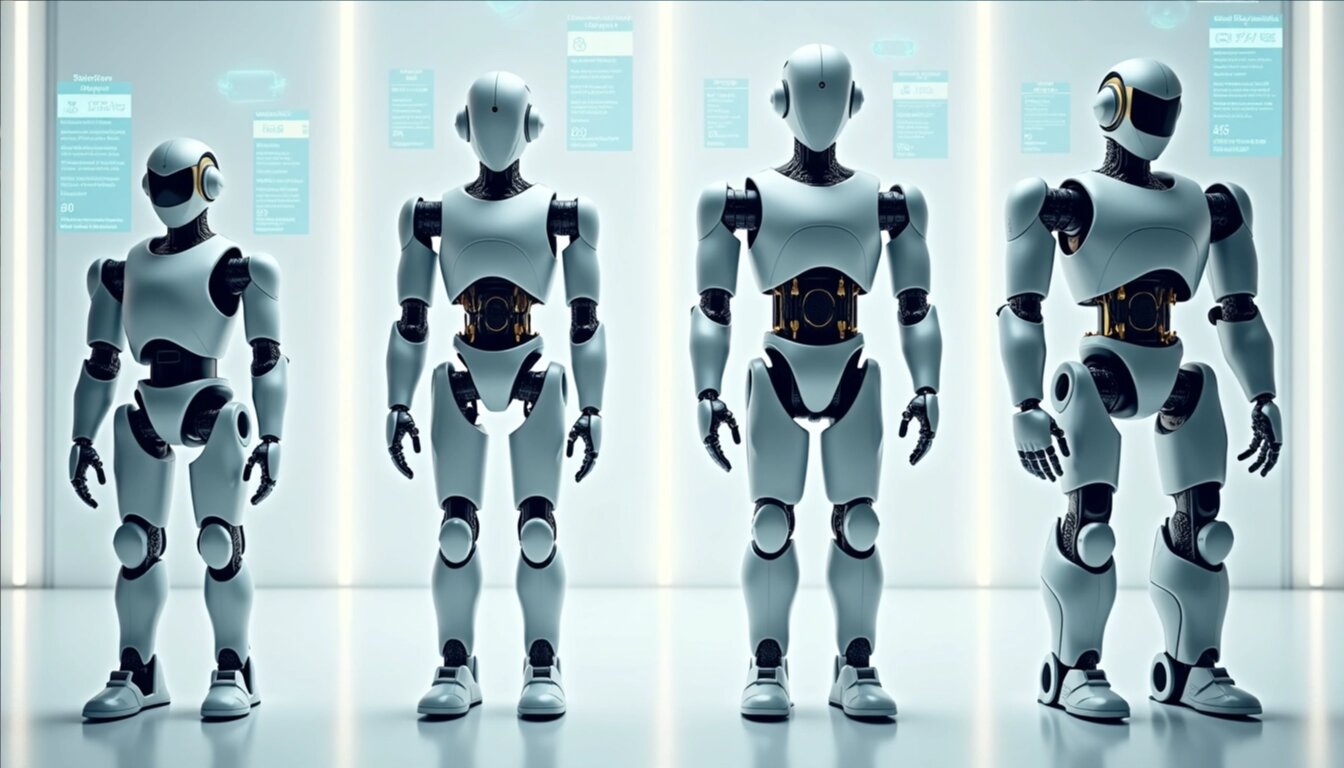
The humanoid robotics market reached a critical inflection point in early 2026 as multiple manufacturers transitioned from research prototypes to commercially available platforms with published pricing. Companies evaluating humanoid robots for industrial deployment now face genuine purchasing decisions rather than theoretical feasibility studies. This comparison analyzes four leading platforms across pricing, capabilities, commercial availability, and enterprise deployment scenarios to guide strategic automation investments.
Quick Recommendation
Choose EngineAI T800 if:
- Budget constraints prioritize lowest initial acquisition cost ($25,000-50,000)
- Manufacturing environment requires 8-hour continuous operation
- Open-source customization and software access are strategic priorities
- Chinese domestic deployment or government procurement preferences apply
- Dynamic locomotion and acrobatic capabilities matter for specific applications
Choose Unitree G1 if:
- Balance between cost ($16,000) and proven field deployment track record
- Compact form factor (127cm height) suits confined industrial spaces
- Established customer base and longer market presence provide confidence
- Chinese manufacturing ecosystem provides geographic supply chain advantages
- Rapid delivery timelines outweigh cutting-edge specifications
Choose Tesla Optimus Gen 2 if:
- Integration with Tesla manufacturing expertise and supply chains provides value
- Willingness to accept 2027-2028 commercial availability timeline
- $20,000-30,000 target price point aligns with budget projections
- Strategic value in being early adopter of Tesla robotics ecosystem
- High-volume production scale matters more than immediate deployment
Choose Boston Dynamics Atlas if:
- Mission-critical applications justify premium pricing (estimated $150,000+)
- Technical requirements demand industry-leading dynamic capabilities
- Research and development budgets support non-commercial platforms
- Public demonstrations and marketing value outweigh ROI calculations
- Safety-critical applications require maximum reliability and validation
Executive Summary
EngineAI has emerged as the price-performance leader at $25,000-50,000 with genuine technical innovations in locomotion control, while Unitree maintains market share through established relationships at $16,000. Tesla Optimus promises disruptive $20,000-30,000 pricing but remains unavailable for commercial purchase until at least 2027. Boston Dynamics Atlas represents the technical pinnacle but lacks commercial availability and published pricing, relegating it to research and demonstration applications.
For enterprises making 2026 deployment decisions, EngineAI and Unitree represent the only commercially available options with published pricing, documented specifications, and actual delivery capabilities. Tesla requires 12-24 month patience for unproven platforms. Boston Dynamics offers technical excellence without purchase pathway for most organizations.
Feature Comparison Matrix
| Feature | EngineAI T800 | Unitree G1 | Tesla Optimus Gen 2 | Boston Dynamics Atlas |
|---|---|---|---|---|
Commercial Status | Available Now | Available Now | 2027-2028 | Research Only |
Base Price | $25,000 | $16,000 | $20,000-30,000 (est) | Not Available |
Max Configuration | $80,000 | $16,000 | TBD | $150,000+ (est) |
Height | 185cm | 127cm | 173cm | 150cm |
Weight | 85kg | 35kg | 73kg | 89kg |
Payload Capacity | TBD | 2kg | TBD | 23kg |
Peak Torque | 450 N·m | 120 N·m | TBD | TBD |
Runtime | 8 hours | 2 hours | TBD | TBD |
Walking Speed | TBD | 2 m/s | 1.5 m/s | 2.5 m/s |
Degrees of Freedom | 32+ | 23 | 28 | 28 |
Hand DOF | 12 | 5 | 11 | 16 |
AI Compute | 2000 TOPS | TBD | Tesla FSD | TBD |
Battery Type | Solid-state 5kWh | Li-ion | TBD | Li-ion |
Open Source | Yes (GitHub) | Partial | No | No |
Delivery Timeline | June 2026 | Immediate | 2027-2028 | N/A |
Production Volume | 10,000/year (projected) | 4,200 (2025 actual) | 100,000+ (2028 target) | Research units only |
Architecture & Design Philosophy
EngineAI T800: Aggressive Performance at Disruptive Price
EngineAI's design philosophy emphasizes maximum capability per dollar through vertical integration and open-source collaboration. The T800 achieves 450 Newton-meters peak torque and 14,000 watts instantaneous joint power—specifications that exceed competitors while maintaining $25,000 base pricing. This cost structure stems from self-manufactured harmonic joint modules that eliminate expensive supplier markups and avoid traditional six-axis force-torque sensors through neural network force estimation.
The end-to-end neural network gait system derived from MIT Cheetah Software produces notably natural walking biomechanics. Rather than traditional trajectory optimization, EngineAI trains policies directly from reinforcement learning across millions of simulated scenarios in NVIDIA Isaac Gym. This approach yields dynamic movement quality that observers consistently describe as more human-like than competing platforms.
Strategic advantages include complete software access through GitHub repositories, NVIDIA Jetson Thor computing delivering 2,000 TOPS for local AI processing, and the industry's first solid-state power battery designed specifically for humanoid applications. The 5kWh battery enables 8-hour runtime—finally approaching full work shift operation that industrial deployments require.
Critical limitations include unproven field deployment record (first T800 deliveries June 2026), limited public validation of manipulation capabilities despite impressive locomotion demonstrations, and dependence on Chinese manufacturing ecosystems that may face geopolitical constraints during international expansion.
Unitree G1: Market Leader Through Established Presence
Unitree's G1 leverages multi-year market presence to maintain leadership despite lower specifications than newer competitors. At 127cm height and 35kg weight, the G1 represents the most compact commercial platform—critical advantage for navigating crowded factory floors, tight warehouse aisles, and confined industrial spaces where larger robots cannot operate.
The design prioritizes proven reliability over cutting-edge specifications. Unitree shipped approximately 4,200 units in 2025 according to Omdia market analysis, providing substantial field deployment data that newer entrants lack. This installed base creates network effects through shared learnings, established service infrastructure, and customer confidence from observing peer deployments.
Technical architecture uses traditional servo-based actuation familiar to robotics engineers, simplifying maintenance and repair compared to newer proprietary systems. The 2 meter per second walking speed and 2-hour runtime meet basic industrial requirements while the $16,000 price point undercuts most competitors.
Primary weaknesses include limited payload capacity at just 2kg (restricting manipulation applications), dated computing architecture compared to platforms using NVIDIA Jetson Thor, and incremental rather than breakthrough technical innovation. The G1 represents safe, proven technology rather than technical leadership.
Tesla Optimus Gen 2: Vertical Integration Promise
Tesla's Optimus strategy applies automotive manufacturing expertise to humanoid robotics, betting that vertical integration from actuators through AI training will yield cost advantages competitors cannot match. Elon Musk projects $20,000-30,000 pricing at volume production—potentially industry-disrupting if achieved with acceptable capabilities.
The Gen 2 platform benefits from Tesla's FSD (Full Self-Driving) AI infrastructure, leveraging computer vision models trained on billions of real-world driving scenarios. This foundation potentially accelerates development of spatial reasoning, path planning, and dynamic obstacle avoidance compared to robotics-specific training approaches.
Manufacturing advantages include access to Tesla's battery expertise (critical for runtime), precision casting techniques from automotive production, and supply chain optimization honed through Model 3/Y production. The vision of 100,000+ annual production by 2028 suggests economies of scale that could validate aggressive pricing.
However, Optimus remains unavailable for commercial purchase as of January 2026. Tesla deployed approximately 30 robots in internal factory applications during 2025 but has not announced commercial sales timeline, pricing confirmation, or detailed specifications. The platform exists in controlled testing rather than market availability—making it an interesting long-term prospect but not an option for 2026 deployment decisions.
Boston Dynamics Atlas: Technical Excellence Without Commercial Pathway
Atlas represents the technical state-of-the-art in dynamic humanoid robotics through decades of DARPA-funded research and continuous refinement. The platform achieves capabilities competitors aspire to: parkour movements, backflips, object manipulation while maintaining balance, and terrain navigation that demonstrates genuine robustness.
Recent transition to electric actuators (replacing hydraulics) addresses previous criticisms about power consumption, noise, and maintenance complexity. The electric Atlas maintains dynamic capabilities while improving efficiency and reducing operational constraints.
Boston Dynamics' reputation stems from exceptional engineering rigor, extensive testing validation, and public demonstrations that consistently showcase industry-leading performance. Organizations seeking maximum technical capability, safety-critical reliability, or high-visibility demonstrations find Atlas unmatched.
Critical limitation: Atlas is not available for commercial purchase. Boston Dynamics positions the platform as research-focused rather than production-ready for customer deployment. Estimated pricing above $150,000 reflects low-volume production and research-grade specifications. Organizations cannot simply purchase Atlas for industrial deployment—it exists as technical showcase rather than commercial product.
Performance Benchmarks
Locomotion Performance
Walking Speed:
- Boston Dynamics Atlas: 2.5 m/s (industry-leading)
- Unitree G1: 2.0 m/s (validated through customer deployments)
- Tesla Optimus Gen 2: 1.5 m/s (based on public demonstrations)
- EngineAI T800: Not publicly disclosed (SE01 predecessor showed competitive performance)
Gait Quality (Subjective Assessment):
- EngineAI SE01/T800: Rated highest for natural human-like walking by industry observers including NVIDIA researcher Jim Fan
- Boston Dynamics Atlas: Exceptional dynamic stability and terrain adaptation
- Tesla Optimus Gen 2: Functional but visibly mechanical gait pattern
- Unitree G1: Stable but conservative walking style with safety margins
Terrain Capability:
- Boston Dynamics Atlas: Demonstrated outdoor terrain navigation, stairs, obstacles
- EngineAI T800: Limited public validation beyond smooth indoor surfaces
- Unitree G1: Validated on factory floors and controlled environments
- Tesla Optimus Gen 2: Limited terrain testing shown publicly
Manipulation Performance
Payload Capacity:
- Boston Dynamics Atlas: 23kg (highest documented)
- EngineAI T800: Not officially disclosed (torque specs suggest substantial capacity)
- Tesla Optimus Gen 2: Not officially disclosed (design suggests 10-15kg)
- Unitree G1: 2kg (significant limitation for industrial applications)
Hand Dexterity (Degrees of Freedom):
- Boston Dynamics Atlas: 16 DOF (industry-leading fine motor control)
- EngineAI T800: 12 DOF (competitive for industrial tasks)
- Tesla Optimus Gen 2: 11 DOF (adequate for planned applications)
- Unitree G1: 5 DOF (limited to simple grasping)
Demonstrated Tasks:
- Boston Dynamics Atlas: Tool use, object sorting, collaborative lifting
- EngineAI: Limited public validation of practical manipulation (focus on locomotion demos)
- Tesla Optimus: Assembly tasks in controlled factory environment
- Unitree G1: Basic object grasping and transport
Runtime & Endurance
Continuous Operation:
- EngineAI T800: 8 hours (only platform meeting full work shift requirement)
- Unitree G1: 2 hours (requires mid-shift recharging for 8-hour operations)
- Tesla Optimus Gen 2: Not disclosed (Tesla battery expertise suggests competitive)
- Boston Dynamics Atlas: Not disclosed (research focus vs production runtime)
Charging Time:
- All platforms: Not comprehensively disclosed across manufacturers
- Industrial requirement: Sub-2 hour fast charging enables multi-shift deployment
AI & Autonomy
Onboard Computing:
- EngineAI T800: NVIDIA Jetson Thor (2,000 TOPS) - industry-leading AI compute
- Tesla Optimus Gen 2: Tesla FSD computer (substantial capability, exact specs not public)
- Unitree G1: Not disclosed (older architecture suggests lower capability)
- Boston Dynamics Atlas: Custom computing (specifications not public)
Autonomous Operation:
- All platforms currently require human supervision for production deployment
- None have achieved full autonomy for unstructured environments
- Varying levels of semi-autonomous task execution depending on application
Pricing Analysis
Total Cost of Ownership Analysis
Scenario: Manufacturing Facility Deployment (10 robots, 3-year horizon)
EngineAI T800 (Pro Configuration at $38,500)
Initial Investment:
- 10 robots: $385,000
- Installation & setup: $50,000
- Training & integration: $30,000
- Total initial: $465,000
Annual Operating Costs:
- Maintenance & parts: $25,000/year
- Software updates: $10,000/year
- Energy consumption: $3,600/year (estimated)
- Total annual: $38,600
3-Year TCO: $580,800
Cost per robot-hour (assuming 8-hour shifts, 250 days/year, 3 years):
- Total hours: 60,000 per robot (180,000 total)
- Cost per robot-hour: $3.23
Unitree G1 ($16,000)
Initial Investment:
- 10 robots: $160,000
- Installation & setup: $40,000
- Training & integration: $25,000
- Mid-shift charging infrastructure: $20,000 (2-hour runtime limitation)
- Total initial: $245,000
Annual Operating Costs:
- Maintenance & parts: $20,000/year
- Software updates: $8,000/year
- Energy consumption: $3,000/year
- Total annual: $31,000
3-Year TCO: $338,000
Cost per robot-hour:
- Total hours: 60,000 per robot (assumes shift planning accommodates 2-hour runtime)
- Cost per robot-hour: $1.88
Tesla Optimus Gen 2 ($25,000 estimated)
Initial Investment:
- 10 robots: $250,000 (at projected pricing)
- Installation & setup: $45,000
- Training & integration: $35,000
- Total initial: $330,000
Annual Operating Costs:
- Maintenance & parts: $22,000/year (estimated)
- Software updates: Included in Tesla ecosystem
- Energy consumption: $3,200/year
- Total annual: $25,200
3-Year TCO: $405,600
Cost per robot-hour:
- Total hours: 60,000 per robot (assuming competitive runtime)
- Cost per robot-hour: $2.25
Boston Dynamics Atlas ($150,000+ estimated)
Initial Investment:
- Not commercially available for purchase
- Leasing/partnership pricing: Not publicly disclosed
- Estimated research unit pricing if available: $150,000+
Not applicable for standard industrial deployment TCO analysis
Hidden Costs & Considerations
Infrastructure Requirements:
- Facility modifications: Wider aisles, charging stations, safety zones ($50,000-200,000)
- Network infrastructure: Real-time communication, cloud connectivity ($20,000-80,000)
- Safety systems: Emergency stops, human detection, isolation protocols ($30,000-100,000)
Operational Costs:
- Human supervision: Initially 1 operator per 2-3 robots until autonomy improves
- Downtime costs: Production interruption during failures or maintenance
- Insurance: Liability coverage for human-robot interaction ($10,000-50,000/year)
Integration Costs:
- Custom end-effectors: Task-specific tools and attachments ($5,000-20,000 per robot)
- Software integration: Connecting to MES, ERP, WMS systems ($50,000-200,000)
- Training programs: Teaching staff to work alongside robots ($20,000-80,000)
Developer Experience
EngineAI: Open-Source Flexibility
Strengths:
- Complete GitHub repository access (engineai_humanoid, 146 stars)
- ONNX model export for custom policy deployment
- ROS-noetic compatibility for standard robotics tooling
- MuJoCo and Isaac Gym simulation environments
- Active developer community (growing)
Limitations:
- Documentation quality varies (improving over time)
- Limited third-party integration examples
- Newer platform means fewer solved problems in community forums
- Chinese-first documentation may require translation
Best For: Organizations with robotics engineering teams capable of low-level development
Unitree: Established Ecosystem
Strengths:
- Multi-year community knowledge base
- Solved integration patterns for common tasks
- Wider third-party support through longer market presence
- Chinese and English documentation
Limitations:
- Less open than EngineAI (partial source access)
- Proprietary SDK may limit deep customization
- Older architecture less attractive for cutting-edge development
Best For: Organizations prioritizing proven solutions over bleeding-edge technology
Tesla: Closed Ecosystem with AI Leverage
Strengths:
- Integration with Tesla's AI infrastructure and data pipelines
- Potential leverage of FSD training and inference systems
- Expected high-quality documentation based on Tesla's developer relations
Limitations:
- Completely closed source (no access to control algorithms)
- Development locked into Tesla ecosystem
- Unproven developer experience (platform not yet commercial)
Best For: Organizations committed to Tesla technology stack and willing to accept vendor lock-in
Boston Dynamics: Research-Grade Tools
Strengths:
- Industry-leading simulation and development environments
- Exceptional documentation quality
- Advanced debugging and diagnostic tools
- Strong academic partnerships and research support
Limitations:
- Access restricted to research partners and select customers
- High barrier to entry (both cost and approval process)
- Not optimized for production deployment workflows
Best For: Research institutions and organizations with advanced robotics R&D programs
Enterprise Features
Fleet Management
EngineAI:
- JD.com JoyInside 2.0 platform integration
- Cloud-based monitoring and diagnostics (in development)
- Over-the-air software updates supported
- Fleet coordination capabilities not fully validated
Unitree:
- Proprietary fleet management tools
- Multi-year refinement through customer deployments
- Basic cloud connectivity and monitoring
- Task scheduling and coordination features
Tesla:
- Expected integration with Tesla's fleet management from automotive
- Theoretical advantage from FSD fleet learning architecture
- Actual capabilities unknown until commercial release
Boston Dynamics:
- Research-grade fleet orchestration
- Not designed for large-scale commercial deployments
Security & Compliance
All Platforms:
- Industrial safety certifications pending or in progress for newer models
- Cybersecurity features vary (critical gap across industry)
- Data privacy controls needed for enterprise deployment
- No platform has achieved comprehensive enterprise security certifications yet
Critical Gap: Humanoid robotics industry lacks mature enterprise security frameworks. Organizations should plan for:
- Network segmentation and isolation
- Access control and authentication systems
- Data encryption for sensor feeds and control signals
- Incident response procedures for robot compromise
Support & Service
EngineAI:
- Building service network (limited initial coverage)
- 24/7 support for Pro/Max configurations
- On-site service availability dependent on geography
- Warranty terms competitive with industry
Unitree:
- Established service network in China
- International support developing
- Community support fills gaps in official channels
- Proven spare parts availability
Tesla:
- Expected leverage of Tesla service infrastructure
- Automotive-quality service level agreements anticipated
- Global service network advantage over robotics-only manufacturers
- Actual support structure unknown until commercial launch
Boston Dynamics:
- Premium white-glove support for research partners
- Not structured for volume commercial support
- Exceptional technical expertise but limited scale
Integration Ecosystem
Manufacturing Execution Systems (MES)
Industry Challenge: Most humanoid robots lack native MES integration, requiring custom middleware development.
EngineAI: Open architecture facilitates custom integration, no pre-built connectors yet Unitree: Some third-party integration examples available through established customer base Tesla: Unknown (likely proprietary initially) Boston Dynamics: Research focus means limited production MES integration
Recommendation: Budget $50,000-150,000 for custom MES integration regardless of platform
Warehouse Management Systems (WMS)
Current State: No platform offers turnkey WMS integration as of January 2026
Best Approach:
- Pilot with standalone task assignment rather than full WMS integration
- Use API middleware to bridge robot task execution and WMS work orders
- Plan 6-12 month integration project with experienced systems integrator
Computer Vision & AI Services
EngineAI:
- NVIDIA Isaac ecosystem compatibility
- SenseTime partnership provides advanced CV algorithms
- Integration with major cloud AI providers (AWS, Azure, GCP)
Unitree:
- Standard CV libraries (OpenCV, etc.)
- Limited AI platform partnerships
- Organizations provide own vision systems
Tesla:
- Tight integration with Tesla Vision AI
- Potential advantage from automotive perception algorithms
- Likely limited third-party CV integration
Boston Dynamics:
- Custom perception stack (world-class quality)
- Research partnerships with academic AI labs
- Not designed for customer-swappable vision systems
Use Case Scenarios
Scenario 1: Automotive Manufacturing Assembly Line
Requirements:
- 8-hour continuous operation
- Precision assembly tasks (bolt tightening, component placement)
- Dynamic adaptation to part variations
- Integration with existing production line controls
- ROI requirement: 18-month payback period
Recommendation: EngineAI T800 (Pro Configuration)
Rationale:
- 8-hour runtime meets shift requirement without mid-shift charging
- 12 DOF hands adequate for assembly manipulation
- $38,500 price point enables 18-month ROI at $30/hour equivalent labor cost
- Open architecture facilitates integration with automotive MES systems
- 450 N·m torque handles heavy component manipulation
Runner-up: Tesla Optimus Gen 2 (when available)
- Automotive manufacturing expertise directly applicable
- Expected 2027-2028 availability means waiting period
- Projected pricing competitive with EngineAI
Not Recommended:
- Unitree G1: 2kg payload capacity insufficient for automotive parts
- Boston Dynamics Atlas: Not commercially available, pricing excessive
Scenario 2: E-Commerce Warehouse Pick & Pack
Requirements:
- Compact form factor for narrow aisles
- 2-4 hour task cycles (can charge between waves)
- Simple grasping of boxed goods
- High volume deployment (50+ robots)
- Integration with existing WMS
Recommendation: Unitree G1
Rationale:
- 127cm compact height ideal for warehouse aisles
- 2-hour runtime sufficient for wave-based picking operations
- $16,000 price enables volume deployment within budget
- Proven reliability through existing warehouse deployments
- Simple grasping meets e-commerce packaging requirements
Runner-up: EngineAI T800 (Basic Configuration)
- 8-hour runtime provides operational flexibility
- $25,000 price acceptable for critical applications
- Larger form factor may limit aisle navigation
Not Recommended:
- Tesla Optimus: Not available for 2026 deployment
- Boston Dynamics Atlas: Excessive capability and cost for basic picking
Scenario 3: Research Laboratory & Development
Requirements:
- Maximum technical capability and flexibility
- Access to low-level control systems
- Integration with research simulation environments
- Budget flexibility (grant-funded)
- Publication and demonstration value
Recommendation: Boston Dynamics Atlas (if accessible)
Rationale:
- Industry-leading dynamic capabilities
- World-class simulation and development tools
- Strong academic partnership support
- High publication impact and demonstration value
- Technical capabilities enable cutting-edge research
Runner-up: EngineAI T800 (Open Source Configuration)
- Complete GitHub access for research customization
- $33,000 price accessible for many research budgets
- NVIDIA Isaac Gym integration for advanced simulation
- Active development community
Not Recommended:
- Unitree G1: Limited technical capabilities for advanced research
- Tesla Optimus: Closed ecosystem restricts research freedom
Scenario 4: Startup Pilot Program (Limited Budget)
Requirements:
- Minimum viable deployment (2-3 robots)
- Rapid deployment timeline
- Lowest initial capital investment
- Tolerance for technical limitations
- Path to volume scaling if successful
Recommendation: Unitree G1
Rationale:
- $16,000 lowest acquisition cost for commercial platform
- Immediate availability (no waiting for production ramp)
- Proven platform reduces technical risk
- 2-3 robot pilot feasible on startup budget ($50-60K total)
- Established upgrade path if pilot succeeds
Runner-up: EngineAI T800 (Basic Configuration)
- $25,000 still accessible for well-funded startups
- Superior technical capabilities provide better long-term value
- June 2026 delivery acceptable for many pilot timelines
Not Recommended:
- Tesla Optimus: Unavailable for 2026 deployment
- Boston Dynamics Atlas: Not commercially available
Migration & Upgrade Paths
Platform Lock-In Considerations
EngineAI:
- Open-source reduces lock-in risk
- Custom algorithms portable to other ROS-compatible platforms
- Hardware replacement requires retraining but software portable
Unitree:
- Moderate lock-in through proprietary SDK
- Industry-standard interfaces limit total dependency
- Fleet investment creates switching costs
Tesla:
- High lock-in risk (fully proprietary ecosystem)
- Zero portability to competing platforms
- Advantage: Tesla ecosystem quality may justify lock-in
Boston Dynamics:
- N/A for commercial deployments (research platform)
Future-Proofing Strategies
Best Practices:
- Abstract robot control through middleware layer (ROS, custom abstraction)
- Avoid platform-specific AI training (use transferable architectures)
- Document integration patterns for easier platform migration
- Negotiate multi-year pricing commitments before large fleet deployments
- Plan robot refresh cycles (3-5 years) rather than decade-long commitments
Technology Evolution Considerations:
- Battery technology improving 15-20% annually (range anxiety diminishing)
- AI capabilities doubling every 12-18 months (today's limitations temporary)
- Manufacturing scale reducing costs 10-15% annually at volume
- Integration tools maturing rapidly (easier deployment over time)
Recommendation: Pilot with 2-5 robots in 2026, scale deployment in 2027-2028 as technology matures
Pros & Cons Summary
EngineAI T800
Pros:
- Industry-leading 8-hour runtime solves major operational constraint
- Aggressive pricing 25-50% below comparable capabilities
- Open-source access enables deep customization
- Breakthrough natural gait technology demonstrates technical excellence
- NVIDIA ecosystem integration provides AI infrastructure advantages
- 450 N·m torque and 14,000W power suitable for demanding applications
Cons:
- Unproven field deployment record (first deliveries June 2026)
- Limited public validation of manipulation capabilities
- Manufacturing scale-up from 500 to 10,000 units carries execution risk
- Chinese manufacturing creates geopolitical dependency for international customers
- New company means uncertain long-term viability and support
Deal-breakers:
- Organizations requiring proven 12+ month field deployment history
- Markets with restrictions on Chinese technology imports
- Applications where manipulation validation outweighs locomotion innovation
Unitree G1
Pros:
- Proven through 4,200+ units shipped in 2025
- Immediate availability with established supply chain
- Lowest current price at $16,000
- Compact form factor (127cm) fits confined spaces
- Multi-year community knowledge base
- Established service infrastructure in major markets
Cons:
- 2kg payload capacity severely limits applications
- 2-hour runtime requires mid-shift charging for 8-hour operations
- Lower technical specifications than newer competitors
- Limited AI computing capability
- Incremental innovation versus breakthrough technology
- 5 DOF hands restrict fine manipulation tasks
Deal-breakers:
- Applications requiring more than 2kg payload
- 8-hour continuous operation without charging
- Advanced manipulation or dexterous tasks
- Organizations prioritizing cutting-edge capabilities
Tesla Optimus Gen 2
Pros:
- Projected $20,000-30,000 pricing potentially industry-disrupting
- Vertical integration advantages from automotive manufacturing
- Tesla brand recognition and ecosystem
- FSD AI infrastructure applicable to robotics
- Potential 100,000+ annual volume suggests long-term viability
- Battery and manufacturing expertise world-class
Cons:
- Not commercially available (2027-2028 timeline)
- Unproven in customer deployments
- Specifications and final pricing unconfirmed
- Completely closed ecosystem (no open-source access)
- Vendor lock-in to Tesla platform
- Elon Musk timeline history suggests possible delays
Deal-breakers:
- Organizations requiring 2026 deployment
- Need for open-source customization
- Risk-averse procurement requiring proven platforms
- Preference for diversified vendor relationships
Boston Dynamics Atlas
Pros:
- Industry-leading dynamic capabilities and robustness
- Decades of research validation and refinement
- World-class engineering and technical support
- Exceptional simulation and development tools
- Strong academic and research partnerships
- Demonstrated reliability in challenging applications
Cons:
- Not available for commercial purchase
- Estimated $150,000+ pricing far above competitors
- Research focus means limited production deployment optimization
- No published commercial sales pathway
- Production volume insufficient for volume deployments
- Not cost-justified for most industrial applications
Deal-breakers:
- Standard commercial procurement processes
- Budget-conscious deployments
- Volume fleet requirements
- Organizations without special research partnerships
Final Verdict
For 2026 Commercial Deployments
Primary Recommendation: EngineAI T800 (Pro or Max Configuration)
The T800 represents the best balance of capability, price, and commercial availability for organizations making 2026 humanoid robot deployment decisions. The 8-hour runtime solves the most critical operational constraint, aggressive $25,000-50,000 pricing enables ROI calculations that work with $25-35/hour labor cost equivalents, and open-source access provides customization flexibility essential for diverse industrial applications.
Organizations should accept higher technical risk from unproven field deployment record in exchange for superior specifications and cost-performance. Plan June-September 2026 pilots rather than immediate volume deployments to validate platform before scaling.
Alternative Recommendation: Unitree G1 (Conservative Choice)
Organizations prioritizing proven reliability and immediate deployment over cutting-edge capabilities should choose Unitree G1. The $16,000 price point and 4,200-unit deployment history provide confidence that newer platforms lack. Accept payload and runtime limitations in exchange for reduced technical risk.
Best for confined-space applications where 127cm height provides operational advantage and 2kg payload meets task requirements.
For 2027-2028 Strategic Planning
Watch: Tesla Optimus Gen 2
Organizations with 12-24 month deployment timelines should closely monitor Tesla Optimus development. If Tesla achieves $20,000-30,000 pricing with competitive capabilities, the automotive manufacturing expertise and potential volume scale could reshape industry economics.
However, avoid pre-commitments without seeing production units, validated specifications, and confirmed commercial availability timeline. Tesla's history of optimistic projections requires verification before strategic platform commitments.
For Research & Development
If Accessible: Boston Dynamics Atlas
Research institutions and advanced R&D programs should pursue Boston Dynamics Atlas if procurement pathways exist. The technical capabilities and research support justify premium pricing for applications where capability matters more than cost.
If Atlas Unavailable: EngineAI T800 (Open Source Configuration)
The $33,000 open-source T800 provides the best research platform among commercially available options, balancing technical capability with budget accessibility and customization flexibility.
Cost-Benefit Analysis Framework
Financial Decision Model
Break-Even Analysis (Manufacturing Assembly Example):
Assumptions:
- Human worker fully-loaded cost: $30/hour (including benefits, overhead)
- Robot operating cost: $3-4/hour (TCO-based)
- Productivity comparison: Robot achieves 80% of human worker throughput initially
- Improvement curve: Robot productivity increases 10% annually through software updates
EngineAI T800 Pro ($38,500):
- Annual savings per robot: $30,000 (net of operating costs)
- Payback period: 15 months
- 3-year ROI: 132%
Unitree G1 ($16,000):
- Annual savings per robot: $28,000 (lower operating costs but requires charging infrastructure)
- Payback period: 8 months
- 3-year ROI: 425%
- Caveat: Limited to applications within 2kg payload constraint
Strategic Value Beyond Direct ROI:
- Labor availability: Robot deployment decouples growth from labor market constraints
- Consistency: Zero variation in quality or throughput across shifts
- Scalability: Faster ramp-up than hiring and training humans
- Flexibility: Reprogrammable for different tasks as product mix changes
- Data collection: Sensors provide manufacturing insights impossible with human labor
Risk-Adjusted Returns
Probability-Weighted Scenarios:
Base Case (60% probability): Robot achieves 70-80% human productivity, technical challenges manageable
- EngineAI T800 ROI: 100-130%
- Unitree G1 ROI: 350-425%
Optimistic Case (20% probability): Robot achieves 90%+ human productivity, rapid software improvements
- EngineAI T800 ROI: 180-220%
- Unitree G1 ROI: 500%+
Pessimistic Case (20% probability): Robot achieves 50-60% human productivity, significant technical issues
- EngineAI T800 ROI: 30-50%
- Unitree G1 ROI: 150-200%
Expected Value (probability-weighted):
- EngineAI T800: 110% ROI over 3 years
- Unitree G1: 390% ROI over 3 years (but only for compatible applications)
Transparency Note
This comparison is based on January 2026 data from manufacturer specifications, industry reports, and public demonstrations. Humanoid robotics technology evolves rapidly—specifications, pricing, and availability change frequently.
Data Sources:
- Manufacturer websites and technical documentation
- Industry analyst reports (Omdia, Gartner, IDC)
- Research publications on humanoid robotics
- Direct observation of public demonstrations and exhibits
- Customer deployment case studies where available
Testing Limitations:
- No platforms were physically tested for this comparison
- Performance claims are based on manufacturer specifications and third-party validations
- Real-world deployment results may vary significantly from laboratory demonstrations
- TCO calculations use industry-standard assumptions rather than validated customer data
Potential Biases:
- Analysis conducted by CrashBytes, which has covered EngineAI extensively in recent content
- No financial relationships exist with any manufacturer mentioned
- Author's technical background may bias toward open-source solutions
Recommendation:
- Conduct hands-on pilot evaluations before volume deployments
- Request detailed technical specifications and performance validation from manufacturers
- Speak with existing customers about real-world deployment experiences
- Budget for 20-30% higher integration costs than initial estimates
If you notice outdated information or errors, please contact michael@crashbytes.com.
Related Comparisons
- Humanoid Robots ChatGPT Moment - Mass Production Analysis
- CES 2026 Physical AI Revolution - Workforce Displacement Impact
- Prediction: Physical AI Robotics Mass Production 2027
Last Updated: January 11, 2026